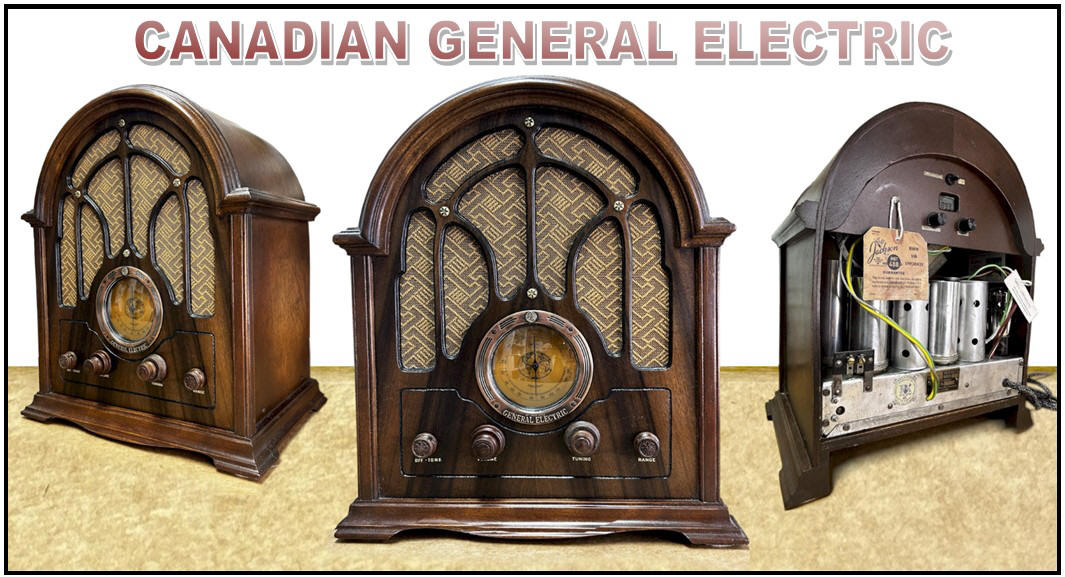
About This Radio
The
General Electric K-64 radio is a classic early–Depression-era tabletop
set that sits right at the transition between simple broadcast receivers and
more advanced multi-band “all-wave” radios. Although often casually referred to
as a 1934 set, it was actually introduced in late 1933 and sold through 1934,
which is why it is commonly associated with that year.
🏭
Manufacture and Origin
The
K-64 was produced by General Electric, with manufacturing centered in:
In
Canada, a closely related version was also built by Canadian General Electric
in Toronto, Ontario, reflecting GE’s common practice of parallel U.S. and
Canadian production for the same chassis design
To
put that into context:
It
was marketed as a high-value, feature-rich set, offering shortwave
capability at a price “that can’t be touched” by competitors at the time.
📻
Technical Overview
The
K-64 is a 6-tube superheterodyne receiver with features that were quite
advanced for its price class:
Tube Lineup
58 (RF amplifier)
2A7
(mixer/oscillator)
58 (IF amplifier)
2B7
(detector/AVC/audio)
2A5 (output)
Key Features
Standard AM
broadcast
Power consumption
~75 watts
The
K-64 stands out for several forward-looking design choices:
✦ “Airplane” Dial
- One of GE’s early uses of a round dial, replacing older rectangular “window” dials
- Became a defining style element of mid-1930s radios
✦ Dual (Coarse + Fine) Tuning
- Concentric knobs allowed precise tuning—especially useful on shortwave
✦ Continuous Tone Control
- Used a potentiometer instead of a stepped switch, which later became standard
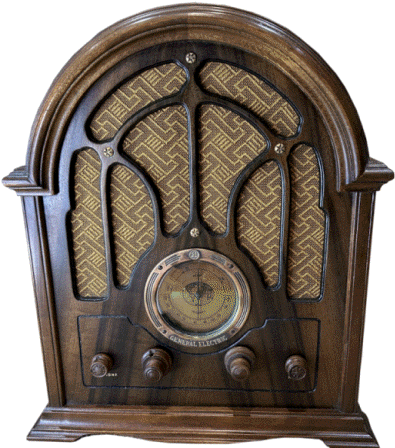
✦ Cabinet Style
- Classic cathedral (Gothic arch) wooden cabinet
- Compact but visually striking—typical of 1933–1935 design trends
An interesting historical note:
The K-64 shares its chassis with the RCA Model 121 radio, because GE was manufacturing sets for Radio Corporation of America at the time .
This makes it part of a broader family of electrically identical radios sold under different brand names.
While surviving records for GE serial numbers are limited, a number like 0223
suggests:
GE
did not maintain widely accessible serial number logs for this period, so exact
production dates tied to serials are rarely traceable—but low numbers
generally indicate early manufacture, which can add collector interest.
 ⭐
Why the K-64 Matters
The
K-64 represents a key moment in radio evolution:
Shared lineage with
RCA sets—linking two major industry players
Today, the K-64 is appreciated for:
This well-restored example—especially with this early Serial No. 223 —
can be both historically significant and visually striking in a collection.